
The first thing that surprises most people when they arrive at the Blue Mosque isn’t the size or the color. It’s the pause. You’re standing in one of the busiest squares in the city, yet the moment you step closer, the pace changes. Shoes come off. Voices drop. Time stretches a little.
That shift matters.
The Sultanahmet Blue Mosque, officially known as the Sultan Ahmed Mosque, is not a museum you breeze through between stops. It’s an active place of worship. That single fact explains almost every confusion first-time visitors face. Why doors close during prayer times. Why Friday mornings work differently. Why the Blue Mosque dress code matters more here than at other landmarks.
According to visitor feedback on Tripadvisor and guidance from established travel resources like Lonely Planet, most frustrations come from timing mistakes, not from the mosque itself. People arrive during prayer closure windows. They queue without knowing why. They feel unsure about what’s allowed.
We’ve seen it happen countless times.
Our guide is written for first-time visitors who want clarity, not ceremony. We’ll explain Blue Mosque opening hours, what happens during prayer times, whether the Blue Mosque is free, how to dress without overthinking it, and how to plan your visit so it fits naturally into a day in Sultanahmet.
You won’t need to memorize rules. You’ll just know what to expect.
We’ll also show you how to pair the Blue Mosque Istanbul with nearby sights like Hagia Sophia without rushing, and what to do if you arrive at the wrong moment. That happens more often than people admit.
Let’s start with the basics you actually need before you go.
Quick facts
Blue Mosque opening hours and prayer closures
The Blue Mosque follows a rhythm that’s simple once you know it. The Blue Mosque Istanbul is open to visitors outside of the five daily prayer times. Each prayer closes the mosque to tourists for roughly 30 to 45 minutes. On Fridays, visitor access starts later, usually after the midday prayer, which means late morning visits don’t work.
According to visitor guidance published by mosque authorities and echoed by Lonely Planet, arriving just after a prayer window reopens is the calmest moment to enter. That timing alone can save you a long wait.
No Regrets Booking Advice
Is the Blue Mosque free to enter?
Yes. Entry to the Sultanahmet Blue Mosque is completely free. There are no tickets, no booking system, and no official tour requirement. Donations are welcome, but never mandatory. If someone suggests otherwise, step back and reassess.
How long should you plan to stay?
Most first-time visitors spend 30 to 45 minutes inside. That’s enough time to settle, observe the details, and understand what you’re seeing without feeling rushed. Add extra time if you enjoy photography or quiet observation.
Istanbeautiful Team tip:
The mosque isn’t about covering distance. It’s about slowing down. Short visits work best when you give them your full attention.
What actually closes the mosque
Closures are not random. They align strictly with prayer times, which shift slightly throughout the year. This explains why opening hours change seasonally. Checking the daily prayer schedule in Istanbul on the morning of your visit removes guesswork.
A small but important detail
Shoes are removed before entry and carried in a bag provided at the entrance. Socks matter more than people expect.
History of the Blue Mosque
Built with intention, not conquest
The Blue Mosque was not built after a military victory, which already set it apart. It became the first mosque of an Ottoman sultan financed directly by the state treasury, at a time when imperial income was under strain. That decision alone shaped how people reacted to it.
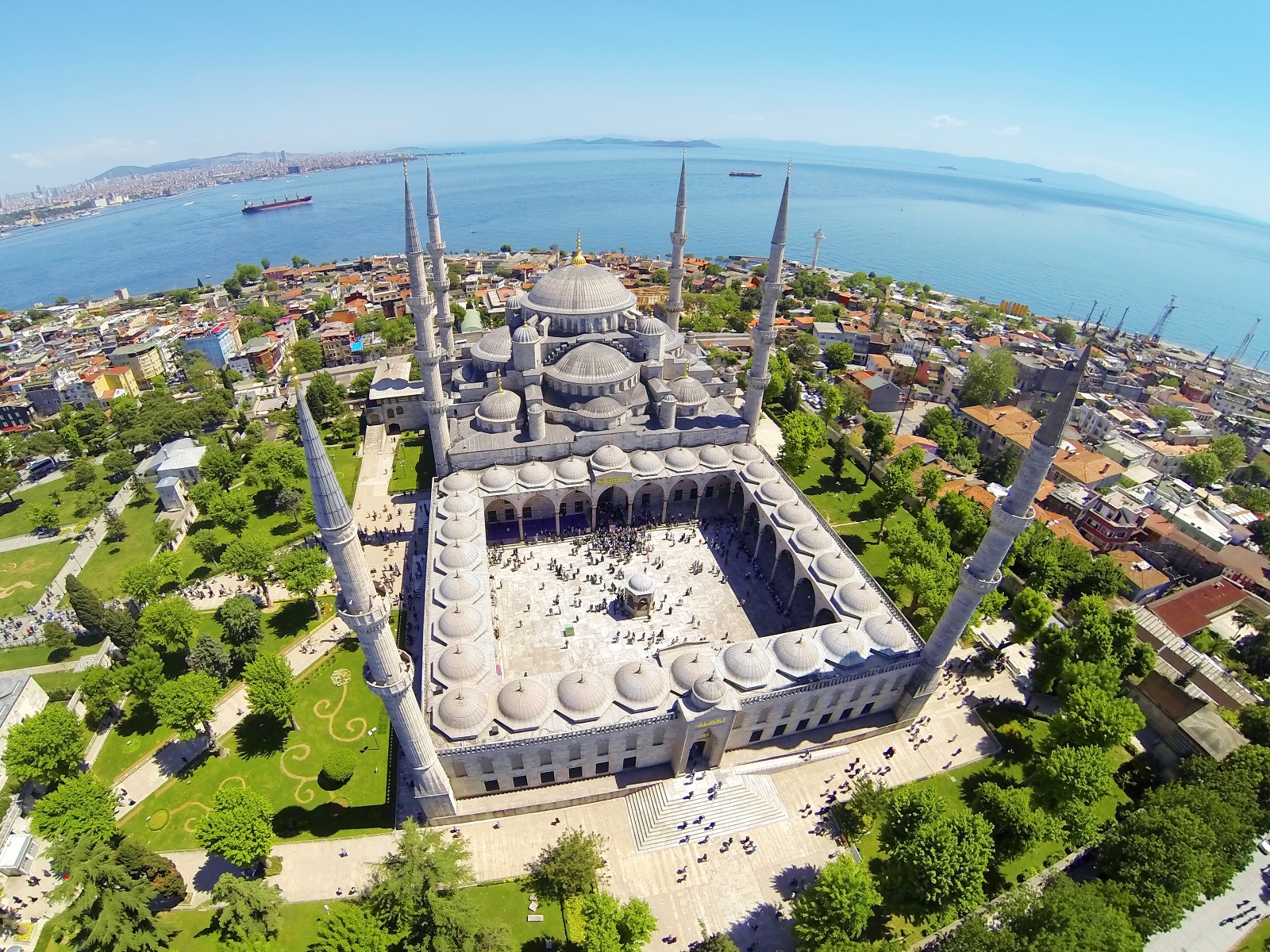
The site itself mattered. The land belonged to the former Ayşe Sultan Palace and was purchased for 30,000 gold coins. Construction began under Sultan Ahmet I, who took an unusually personal role. Historical accounts note that he struck the first blow at the groundbreaking ceremony himself. His pickaxe is still preserved and displayed today at Topkapi Palace.
Istanbeautiful Team insight:
Visitors often miss this detail, but knowing the sultan was personally involved changes how the mosque feels. It was a statement of devotion, not dominance.
The six-minaret controversy
When the mosque was completed, criticism followed quickly. The most talked-about issue was its six minarets, a feature shared only with the Mecca Mosque at the time. Many felt this created an uncomfortable comparison.
The response was pragmatic. Sultan Ahmet I ordered the construction of a seventh minaret in Mecca, easing the tension. The moment matters because it shows how symbolism carried real weight in the Ottoman world.
A larger complex, mostly gone
The mosque once anchored a full complex, including a medrese, a sultan’s pavilion, an almshouse, and a hamam. Most didn’t survive. What remains today is the mosque, the tomb of Sultan Ahmet I, a historic sundial in the courtyard, and nearby, the Great Palace Mosaics Museum, preserving fragments of Byzantine Constantinople.
Best time to visit the Blue Mosque
The quiet windows most first-time visitors miss
The best time to visit the Blue Mosque is not early morning in the generic sense. It’s right after a prayer window reopens. That moment is when worshippers have exited, tour groups haven’t regrouped yet, and the interior feels balanced rather than crowded.

On weekdays, this usually means mid-morning or early afternoon, depending on the season.
According to timing guidance shared by mosque staff and reinforced by traveler reports on Tripadvisor, the calmest entries happen in the first 20 to 30 minutes after reopening. Arrive just before a closure and you’ll wait. Arrive just after, and you walk straight in.
Fridays work differently
This is where many plans fall apart. On Fridays, the Sultanahmet Blue Mosque prioritizes congregational prayer. Tourist access starts later than other days, often after midday. Showing up Friday morning almost guarantees confusion and lines.
If Friday is your only option, plan something nearby first. Walk the Hippodrome. Visit Hagia Sophia’s exterior. Return later when the mosque opens to visitors.
Istanbeautiful Team advice:
Friday mornings are for worship, not sightseeing. Accept that, and the day flows better.
Seasonal crowd reality
Spring and autumn bring the highest visitor numbers, especially between 10:30 and 15:00. Summer adds heat and longer daylight, which stretches visiting hours but also increases group tours. Winter visits feel calmer, except during holidays.
How long to wait if you mistime it
Prayer closures usually last 30 to 45 minutes. If a rope is up, ask staff politely how long remains. Guessing leads to frustration. Knowing the wait makes it manageable.
Timing is everything here. Once you master it, the mosque feels welcoming rather than restrictive.
What you’re actually looking at inside
Start with the light, not the details
When you step inside the Blue Mosque, resist the urge to scan everything at once. Look up. The first thing to notice is light. It filters through hundreds of windows, softening the space and pulling your eyes toward the domes. This is intentional.
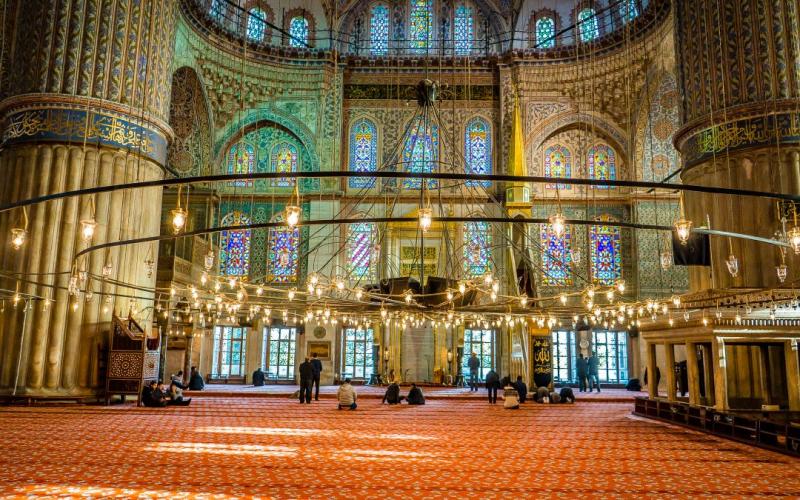
According to architectural notes summarized by Lonely Planet, light here guides attention upward, then inward.
Stand still for a moment. Let your eyes adjust. The room feels quieter when you do.
The domes and why they feel balanced
The main dome doesn’t dominate alone. Smaller domes cascade outward, distributing weight and sound. That layered geometry keeps the interior open rather than imposing. You’ll notice how voices fade quickly. Acoustics matter in active prayer spaces.
The blue tiles everyone mentions
Yes, the tiles are why people call it the Blue Mosque Istanbul. More than 20,000 İznik tiles line the interior, many with floral patterns in blues, greens, and soft reds. Look closely. You’ll see variation. Handwork shows itself in small inconsistencies, which is part of the beauty.
Istanbeautiful Team insight:
The tiles aren’t meant to impress you instantly. They reward slow looking. Pick one panel and stay with it.
Calligraphy and what it signals
Arabic calligraphy runs along the upper walls and domes. You don’t need to read it to understand its role. It frames the space with meaning, guiding attention without decoration overload. According to mosque guides, this balance keeps the focus on prayer rather than spectacle.
The six minarets story, briefly

Outside, the mosque’s six minarets once caused controversy, matching the Grand Mosque in Mecca. The solution was simple. A seventh minaret was added to Mecca. Context matters here. Architecture carries history, not just form.
You don’t need to see everything. Notice a few elements well, and the visit stays grounded.
Guided tours at the Blue Mosque Istanbul
Do you actually need a guided tour?
Guided tours at the Blue Mosque Istanbul can be useful, but only in specific situations. If this is your first mosque visit ever, or if you want historical context without piecing things together yourself, a short guided visit adds value. You’ll understand why certain architectural choices matter, how prayer shapes the space, and what details most people overlook.
That said, not every visitor benefits equally. The mosque is visually intuitive. Silence, light, and scale do a lot of the explaining on their own.
Istanbeautiful Team insight:
We recommend guided tours for context lovers, not checklist travelers. If you prefer absorbing a place quietly, self-guided works better here.
How official and informal tours work
There is no mandatory tour system. Licensed guides operate in the square and through tour companies. Most guided visits last 30 to 45 minutes, which fits the natural attention span inside the mosque. Tours pause during prayer times like everyone else.
According to visitor feedback on Tripadvisor, the best experiences come from guides who explain briefly outside, then let the group experience the interior calmly. Tours that talk nonstop inside tend to feel rushed or intrusive.
What guided tours do well
Good guides explain the six minarets controversy, the role of Sultan Ahmet I, tile symbolism, and how the mosque functioned as part of a larger complex. They also handle etiquette smoothly, which reduces first-time anxiety.
When to skip a guide
If you’re short on time, arriving just after a prayer reopening, or visiting with kids, guided tours can slow you down. In those cases, a self-paced visit followed by reading or reflection works better.
Our Top Picks
Dress code and etiquette
Blue Mosque dress code
The Sultanahmet Blue Mosque asks for modest dress because it’s an active place of worship. For women, shoulders and knees need to be covered, and a headscarf is required. For men, shorts above the knee and sleeveless tops don’t work. That’s it. No color rules. No special fabrics. Comfort matters.
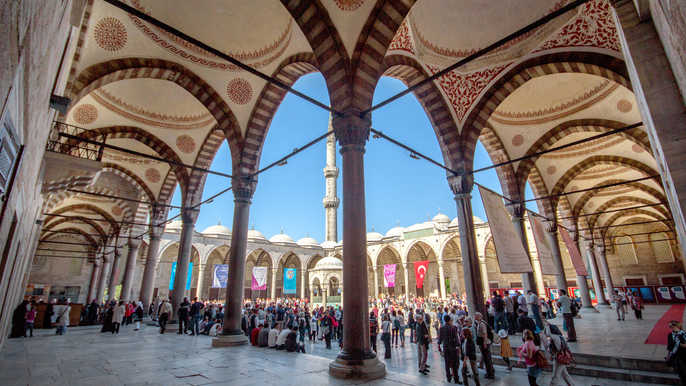
If you arrive unprepared, you won’t be turned away. Scarves and cover-ups are provided at the entrance. They’re clean and practical, though having your own feels easier.
This comes up often in traveler reviews on Tripadvisor, where people worry they’ll “get it wrong”. You won’t, as long as you’re open to adjusting.
Shoes, bags, and the small details
Yes, you remove shoes at the Blue Mosque. Bags are provided to carry them inside. Wear socks. Stone floors stay cool year-round, and bare feet distract from the experience.
Large backpacks slow entry and draw attention. A small daypack or crossbody bag works best. Phones should be on silent. Conversations stay low. Think library volume, not whispering.
Photography
Photography is allowed, but flash is not. Avoid close-ups of people praying. If you’re unsure, step back. Wide shots of the domes, tiles, and light feel respectful and capture more anyway. According to guidance echoed by mosque staff and travel authorities, restraint matters more than rules here.
Behavior that keeps the visit smooth
Sit only where permitted. Avoid walking directly in front of someone praying. If staff redirect you, it’s about flow, not criticism.
Dress and etiquette aren’t barriers. They’re cues. Once you follow them, the mosque opens up.
What to do if you arrive during prayer time
Arriving to find the entrance closed is the most common first-time frustration at the Blue Mosque. The rope isn’t a rejection. It’s timing. The Blue Mosque Istanbul closes to visitors during each of the five daily prayers. Closures usually last 30 to 45 minutes, sometimes a bit longer on Fridays.
According to on-site guidance shared by mosque staff and echoed by visitor reports on Tripadvisor, the reopening window depends on how quickly the prayer concludes and the space resets. That’s why posted times feel approximate.
Don’t wait in place
Standing in line during a closure drains patience fast. Movement helps. Use the pause instead of fighting it. Walk the perimeter. Sit on the square steps. Watch how the space changes. When doors reopen, lines move quickly.
Istanbeautiful Team advice:
If you see the rope, step away for 20 minutes. Waiting right there rarely saves time and usually costs energy.
A short loop that works every time
From the mosque entrance, walk toward the Hippodrome area. Take in the open space. Circle back slowly. This keeps you close enough to return easily without feeling stuck. If you want more context, walk toward Hagia Sophia and observe its exterior. Even ten minutes there reframes the wait.
Friday reality check
On Fridays, the Sultanahmet Blue Mosque opens to visitors later than other days. Morning access doesn’t happen. If you arrive early, treat it as a square visit, not a mosque visit. Come back after midday prayer ends.
Ask instead of guessing
Staff near the entrance answer one question clearly. “How long?” Ask politely. You’ll get a real estimate. Guessing creates frustration. Knowing the wait makes it manageable.
Prayer closures aren’t interruptions. They’re part of how the mosque functions. Once you accept that, the visit flows.
How to get to the Blue Mosque Istanbul
The Blue Mosque sits in Sultanahmet Square, which makes access easy if you pick the right route. For most visitors, the T1 tram is the simplest option. Get off at Sultanahmet stop. From there, it’s a flat, five-minute walk across the square. No hills. No guesswork.

Walking from nearby sights works too. From Hagia Sophia, it’s a two-minute stroll. From the Basilica Cistern, slightly longer but still direct. Taxis sound convenient, but drop-off points are limited and traffic builds fast around the square. You often walk more after the ride than you would from the tram.
According to city transport guidance and repeated traveler feedback on Google Maps, the tram keeps energy intact before you enter.
Which entrance
This matters more than most guides admit. The visitor entrance is on the side facing Sultanahmet Square, clearly signed. Worshippers use different access points. Follow the signs. Don’t improvise. Staff redirecting you isn’t a setback, just crowd flow.
Arrive with bags zipped and hands free. Security checks are brief but steady. Large bags slow the line. If you’re traveling light, you move faster.
Istanbeautiful Team tip:
Enter from the square side, not the park. The flow is clearer, and first impressions feel calmer.
Accessibility notes
Wheelchair access exists, though routes vary by crowd and prayer schedule. Staff assist when possible. Plan extra time and avoid peak mid-day windows.
A small timing trick
If you arrive during a prayer closure, don’t wait in place. Walk the square, take in the exterior, then return when doors reopen. Standing still amplifies frustration.
Pair the Blue Mosque Istanbul with nearby sights
The smart same-day pairing logic
The Blue Mosque Istanbul works best when it anchors your morning or early afternoon, not when it’s squeezed between too many stops. The key is sequencing around prayer closures. Visit the mosque first, or plan it right after another attraction that can absorb timing shifts.
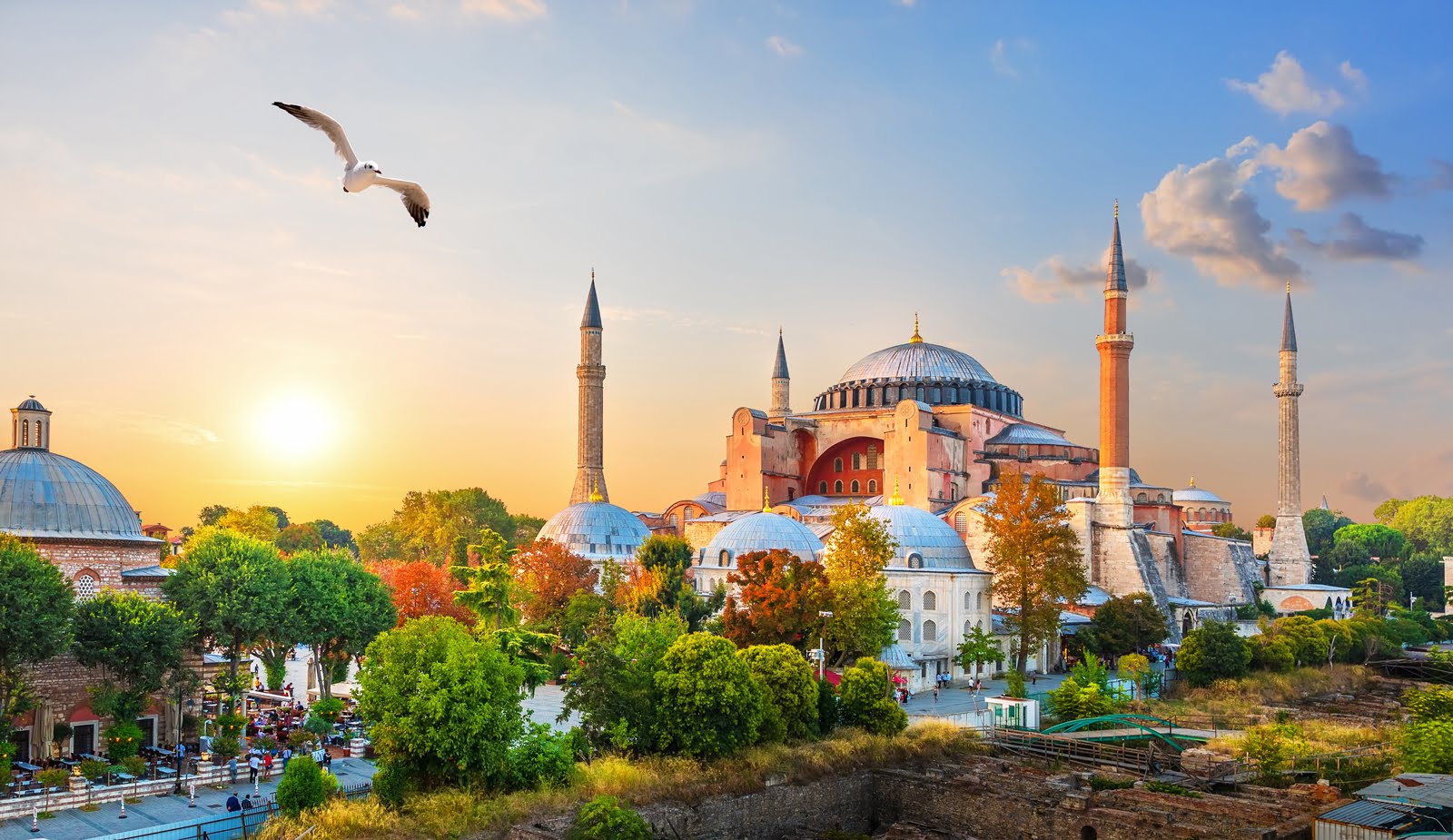
The most natural pairing is Hagia Sophia. They face each other across the square, yet the visiting rhythm is different. If the Sultanahmet Blue Mosque is closed for prayer, Hagia Sophia often remains accessible. When Hagia Sophia queues grow, the mosque may be reopening. This back-and-forth saves time and nerves.
Adding one more stop, not three
If you want a third sight, choose Basilica Cistern. It’s indoors, close by, and doesn’t compete with mosque timing. The cool, dim space also balances the brightness of the square.
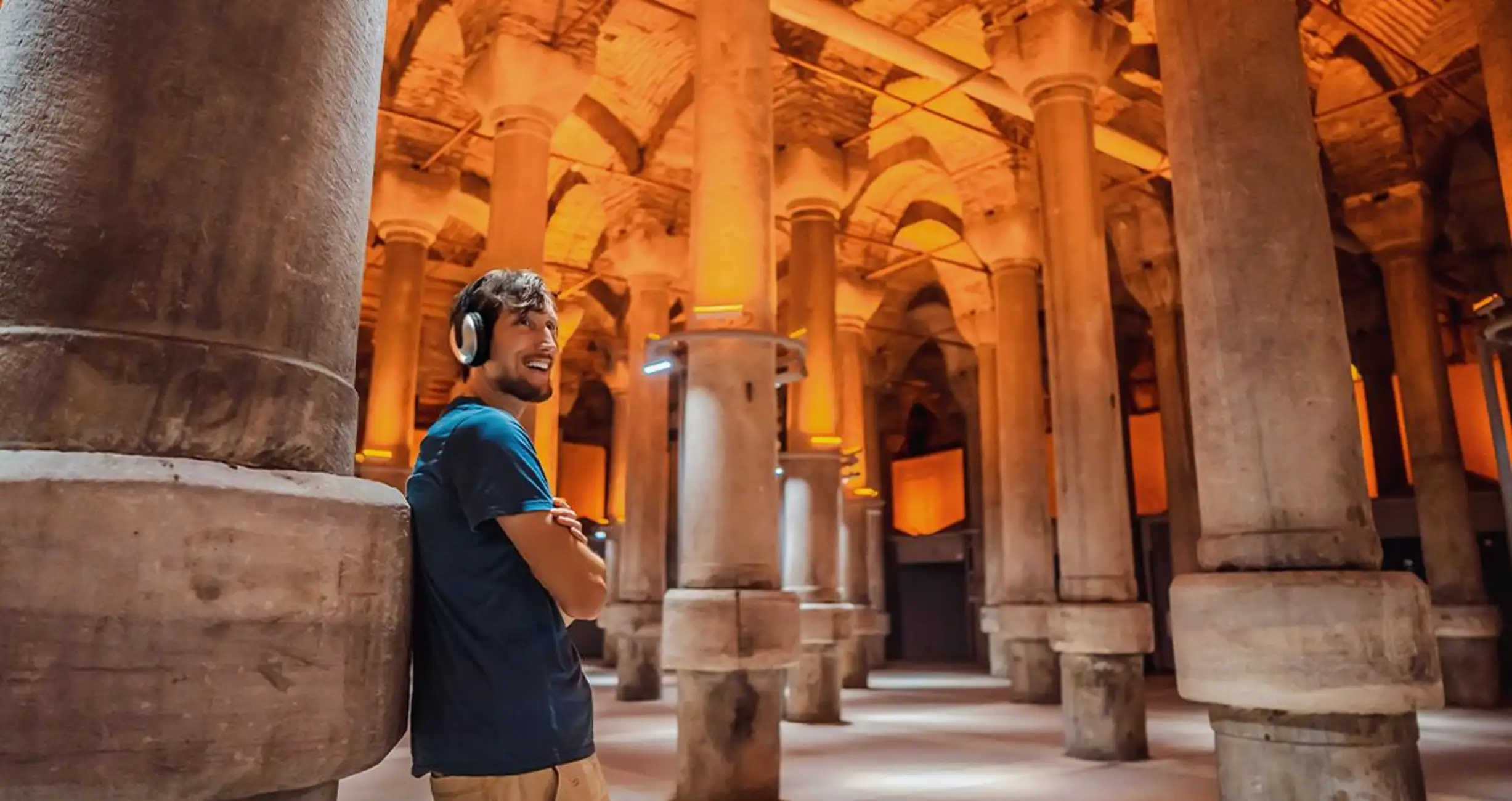
According to visitor feedback on Tripadvisor, this pairing reduces fatigue compared to stacking large museums.

For history-focused travelers with more time, Topkapi Palace works, but only if you commit half a day. Trying to rush Topkapi after the mosque leads to overload.
A realistic half-day flow
Start at the Blue Mosque Istanbul just after a prayer reopening. Spend 30 to 45 minutes inside. Cross to Hagia Sophia next. Take a break in the square. Finish with the Basilica Cistern. Stop. Eat. That’s a full, satisfying block.
What to skip on the same day
Avoid stacking multiple interior-heavy sites back to back. Attention drops fast. Leave something for tomorrow.
Common first-time mistakes
Showing up at the wrong moment and assuming something is wrong
This is the most common one. Visitors arrive, see a rope, and assume the Blue Mosque Istanbul is closed for the day. It isn’t. It’s closed for prayer. The difference matters. Closures are temporary and predictable. According to timing guidance shared by mosque staff and echoed in Tripadvisor reviews, most waits fall under 45 minutes.
The fix is simple. Ask how long. Walk the square. Return calmly.
Treating it like a museum instead of a mosque
The Sultanahmet Blue Mosque isn’t designed for constant movement and commentary. Some visitors rush, whisper loudly, or focus only on photos. That creates tension, both internally and around you. Slow steps. Fewer photos. More observation. The experience improves immediately.
Wearing outfits that are “almost okay”
Shorts that just reach the knee. Sleeveless tops with a scarf ready. These cause delays. You’ll stop. Adjust. Repack. It breaks the rhythm. Dress clearly within the Blue Mosque dress code from the start and entry stays smooth.
Overloading the same time block
Trying to visit the Blue Mosque, Hagia Sophia, Topkapi Palace, and the Basilica Cistern back to back sounds efficient. It isn’t. Mental fatigue shows quickly in sacred spaces. Visitors who stack too much report feeling detached rather than inspired.
Prioritizing photos before context
Taking photos immediately pulls attention outward. Stand still first. Let your eyes adjust. According to guidance summarized by Lonely Planet, understanding the space comes before documenting it.
Ignoring Friday reality
Friday mornings don’t work for tourists. Showing up anyway leads to frustration. Plan around it. The mosque isn’t being difficult. It’s doing what it exists to do.
Most mistakes come from rushing or guessing. Slow down. Ask once. Observe more.
Common Visitor Questions
Is the Blue Mosque Istanbul free to enter?
Yes. Entry to the Blue Mosque is completely free. There is no ticket desk and no reservation system. Donations are welcome but optional. If anyone suggests an entry fee, step back and reassess.
Is the Blue Mosque open on Fridays?
Yes, but visitor access starts later. Friday is the main congregational prayer day, so the mosque opens to tourists after the midday prayer. Morning visits do not work on Fridays. Plan another nearby stop first and return later.
What time is the Blue Mosque closed for prayer?
The mosque closes to visitors five times a day during prayer. Each closure usually lasts 30 to 45 minutes. Times shift slightly by season. Checking the daily Istanbul prayer schedule on the morning of your visit removes guesswork.
How long should you spend inside?
Most first-time visitors spend 30 to 45 minutes. That’s enough to observe the space without rushing. Staying much longer doesn’t add clarity and can pull focus away from the experience.
Do women need to wear a headscarf?
Yes. A headscarf is required for women. Shoulders and knees must be covered. Men should avoid shorts above the knee and sleeveless tops. If needed, cover-ups are provided at the entrance.
Do you remove shoes at the Blue Mosque?
Yes. Shoes are removed before entry and carried in a provided bag. Socks are strongly recommended.
Can you take photos inside?
Photography is allowed. Flash is not. Avoid photographing people who are praying. Wide shots of the interior are always safe.
Is it respectful to visit as a non-Muslim?
Yes. Visitors of all backgrounds are welcome when they follow etiquette and timing.
Blue Mosque: 10 Fascinating Facts
Before we get into Blue Mosque visiting tips and guided tours, here are some amazing facts about this architectural masterpiece!
✔ Built between 1609 and 1616 during the reign of Sultan Ahmed I.
✔ Designed by Sedefkar Mehmet Aga, a student of the legendary Mimar Sinan.
✔ Named after its stunning blue İznik tiles, which decorate the interior walls.
✔ Features a 43-meter-high dome and six minarets, which was controversial at the time.
✔ One of Istanbul’s largest mosques, accommodating up to 10,000 worshippers.
✔ Still an active mosque, closed to tourists during prayer times.
✔ Sultan Ahmed I personally worked on the construction, even carrying soil himself.
✔ The pickaxe used by the Sultan is now displayed in Topkapı Palace.
✔ Visitors must remove their shoes and dress modestly—women should cover their heads.
✔ Entry is free, making it one of the most accessible must-visit landmarks in Istanbul.
Now, let’s explore how to visit the Blue Mosque, best times to go, guided tours and what to expect inside!
Quick Info
The Blue Mosque, known as Sultan Ahmed Mosque in Turkish, is one of Istanbul’s most iconic landmarks. was built in the 17th century (1603-1617) by Sedefkar Mehmet Aga (2nd important architect after Mimar Sinan) with the order of Sultan Ahmet I.
Located in the Sultanahmet neighborhood of Fatih district, along the Sultanahmet Sqaure, the Blue Mosque is a great sample of the Turkish and Islamic architecture and one of the most visited sights and mosques in Istanbul. It can also be considered as a triumph of harmony, proportion and elegance.
As a functioning mosque, it remains a vital place of worship while also attracting millions of tourists annually.
The Blue Mosque stands as a testament to the architectural prowess and cultural richness of the Ottoman Empire. Its name comes from the very beautiful blue interior “Iznik tiles”.
It was the only mosque with six minarets in the world, but now shares this reputation as a new mosque named “Camlica Mosque” is constructed in the Camlica Hill of Istanbul’s Asian side in 2019.
No Regrets Blue Mosque Tours
If you are looking for the best Blue Mosque guided tours, trust our recommendations, save time and money, we have you covered. Below are some of best experiences you can find! Feel free to book online in advance (as you’ll get discounts), by choosing the eco-friendly option of online tickets.
- Combo: Blue Mosque, Basilica Cistern & Hagia Sophia Tour (one of the best)
- Blue Mosque and Sultanahmet Square Tour & Historian Guide
History of the Blue Mosque
Blue Mosque is the first mosque of an Ottoman Sultan, constructed with an allowance from the treasury of the Ottomans. It was built on the site of the former Ayse Sultan Palace, since the site was bought for 30,000 gold. Sultan Ahmet I and many other statesman have worked on the construction of the mosque. It is also known that, Sultan Ahmet I made the first hit on the mosque’s groundbreaking ceremony and his pickax is exhibited in the Topkapi Palace.
After the completion of the mosque, it received a big criticism from the different parts of the community. Main reason for this, was the mosque’s having 6 minarets like the holy Mecca Mosque which generates kind of a competition on people’s minds.
And the 2nd reason was the high amount of money spent despite the decrease in the income of the Empire. After, when Sultan Ahmet I ordered to build the 7th minaret in the holy Mecca Mosque, some of those criticism ended.
The site of the Blue Mosque used to be a big complex including many buildings such as a Medrese (a Moslem theological school), Sultan’s pavilion, an Almshouse and Hamam (Turkish Bath). Majority of those building couldn’t survive until today.
Anyways, you may see the tomb of Sultan Ahmed I and a sundial at the courtyard of the Blue Mosque. The famous Great Palace Mosaics Museum, an impressive mosaics museum preserved from the from the Great Palace of Constantinople also situated at the site of the complex.
Architecture and Design of the Blue Mosque
The architecture of the Blue Mosque Istanbul is a stunning example of Ottoman design, characterized by its grand scale and intricate details. The mosque’s exterior is dominated by its six minarets, an unusual feature as most mosques typically have one, two, or four minarets.
The central dome, flanked by smaller domes, rises to a height of 43 meters, creating an imposing yet elegant silhouette.
The interior of the Blue Mosque is equally breathtaking. The walls are adorned with over 20,000 handmade Iznik ceramic tiles in various shades of blue, giving the mosque its distinctive name.
These tiles feature traditional Ottoman designs, including flowers, trees, and abstract patterns. The expansive prayer hall, capable of accommodating up to 10,000 worshippers, is illuminated by 260 windows, many of which contain exquisite stained glass.
Symbolism and artistry are prevalent throughout the mosque’s design. The use of geometric patterns, floral motifs, and calligraphy reflects Islamic artistic traditions and the importance of harmony and balance.
The mihrab, made of finely carved marble, and the minbar, used for sermons, are focal points within the prayer hall, emphasizing the mosque’s role as a place of worship and spiritual reflection.
Our Recommendation: We Booked These Guided Tours for the Blue Mosque
Since it is a functioning mosque, visiting can be tricky due to prayer schedules and large crowds.
To make the most of our visit, we booked a guided tour in advance, and we highly recommend doing the same! We chose the Blue Mosque Guided Tour, which provided fast access and expert insights into the mosque’s rich history and design.
If you want to explore both the Blue Mosque and Hagia Sophia, the Blue Mosque & Hagia Sophia Guided Tour is a great option, as it includes entry to Hagia Sophia and a professional guide.
Guided Tours and Prices for the Blue Mosque
How much do Blue Mosque guided tours cost?
| Tour Option | Price per Person | Book Now |
|---|---|---|
| Blue Mosque Guided Tour (Our Pick!) | €15 | Book Now |
| Blue Mosque & Hagia Sophia Guided Tour (Includes Entry) | €49 | Book Now |
Which Guided Tour Should You Choose?
Each option offers a unique experience. Here’s what you get with each one:
1. Blue Mosque Guided Tour (€15) – Our Pick!
✔ A 30-45 minute expert-guided tour inside the Blue Mosque
✔ Learn about its history, architecture, and cultural significance
✔ No entrance fee required (Blue Mosque is free to enter)
✔ Best for those who want a short but informative experience
Best for: Travelers who only want to visit the Blue Mosque with a guide.
2. Blue Mosque & Hagia Sophia Guided Tour (€49)
✔ Includes entry to Hagia Sophia (normally €25)
✔ Guided tour of both landmarks, covering their Byzantine and Ottoman history
✔ Saves time by combining two top sites into one experience
✔ Best for history lovers and first-time visitors to Istanbul
Best for: Those who want a comprehensive guided experience covering both major landmarks.
Is a Blue Mosque Guided Tour Worth It?
Yes! While entry to the Blue Mosque is free, a guided tour enhances the experience, helping you understand the mosque’s history, design, and cultural importance.
✔ If you’re on a short trip, a guide helps you make the most of your time.
✔ If you’re visiting during peak hours, a guide can help navigate crowds efficiently.
Our Tip: If you’re also planning to visit Hagia Sophia, book a combo tour to save time and money.
Our Blue Mosque Experience
At first glance, the Blue Mosque (Sultanahmet Mosque) takes your breath away. Its majestic domes, towering minarets, and intricate details command attention, and as you step inside, the feeling is indescribable.
Every visitor experiences something unique—whether it’s a sense of peace, awe, or admiration for its architectural beauty.
Located in the heart of Sultanahmet, next to Hagia Sophia, the Blue Mosque is a living masterpiece of Ottoman design. It has been a UNESCO World Heritage Site since 1985 and continues to be one of the most visited mosques in the world.
What to Expect Inside the Blue Mosque
A Masterpiece of Ottoman Architecture
✔ The five main domes, six minarets, and eight secondary domes create a striking silhouette against Istanbul’s skyline.
✔ The hand-painted blue Iznik tiles decorating the walls give the mosque its famous name.
✔ At night, the mosque is illuminated by soft blue lights, making it even more breathtaking.
Tip: The best views of the mosque’s exterior are from Sultanahmet Square or the gardens between the Blue Mosque and Hagia Sophia.
The Stunning Interior: A Play of Light and Color
Inside, the Blue Mosque’s interior is just as mesmerizing as its grand exterior.
✔ Over 20,000 hand-painted Iznik tiles, each featuring delicate tulip, flower, and cypress motifs.
✔ More than 200 intricately designed stained glass windows allow natural light to filter in.
✔ The high domes and semi-domes create an overwhelming sense of openness and grandeur.
✔ Chandeliers decorated with ostrich eggs were historically believed to prevent cobwebs and spiders.
✔ The walls are adorned with Quranic verses, created by Seyyid Kasim Gubari, one of the greatest calligraphers of his time.
Tip: Look up! The domes and semi-domes are decorated with stunning blue and gold patterns, making them a true work of art.
Prayer Hall & Worship Area
✔ The central prayer hall is covered in soft carpets, regularly donated by worshippers.
✔ The mihrab (prayer niche) and minbar (pulpit) are made of white marble, beautifully carved with Islamic motifs.
✔ Visitors are welcome, but must respect prayer times—non-Muslim visitors are not allowed inside during prayers.
Tip: The best time to visit is outside prayer hours, as the mosque remains an active place of worship.
A Peaceful & Spiritual Atmosphere
✔ The soft lighting, spacious halls, and high ceilings create a serene and spiritual ambiance.
✔ The quietness of the mosque invites visitors to pause, reflect, and appreciate its sacred beauty.
✔ Despite its popularity among tourists, the mosque retains its peaceful and welcoming atmosphere.
Tip: Dress modestly when visiting—women should cover their heads, and shorts and sleeveless tops are not allowed.
Visiting Tips for the Blue Mosque
Location
The Blue Mosque is situated in the Sultanahmet neighborhood of Fatih district, along the Sultanahmet Sqaure, just across the famous Hagia Sophia Museum and Museum of Turkish and Islamic Arts. See the location map.
Opening Hours
The Blue Mosque is open daily, but as it is an active place of worship, it closes to tourists during prayer times (five times a day).
Tip: The best time to visit is early in the morning or late afternoon, outside prayer hours, to avoid long waits.
Entry Fee
✔ Entrance is free, as it is an active mosque.
✔ However, guided tours (€15-€49) are available for those who want a deeper historical insight.
We’ve covered all ticket and guided tour options earlier in this article—scroll up for details!
Visiting Tips
✔ Dress modestly – Women must cover their hair, and everyone should wear clothing that covers shoulders and knees.
✔ Bring a scarf – Scarves are available at the entrance, but bringing your own is more convenient.
✔ Shoes must be removed – Bags are provided to carry your shoes inside the mosque.
✔ Photography is allowed, but be respectful—avoid taking photos during prayers.
✔ Avoid Fridays during noon prayer, as it is the busiest time for worshippers.
✔ Keep an eye out for unofficial guides (guides should have official badge on).
Accessibility
✔ The mosque is wheelchair accessible, with ramps and spacious interiors.
✔ Shoes must be removed, but wheelchair users can keep them on if using protective covers.
Tip: Visit outside peak hours for a more peaceful and comfortable experience.
Nearby Attractions
The Blue Mosque is in the heart of Sultanahmet, surrounded by other must-visit landmarks:
✔ Hagia Sophia – One of Istanbul’s most famous landmarks, located right across from the mosque.
✔ Basilica Cistern – A mystical underground water reservoir, just a short walk away.
✔ Topkapi Palace – The grand residence of Ottoman sultans, filled with treasures and history.
✔ Hippodrome of Constantinople – An ancient chariot-racing arena, featuring the Egyptian Obelisk and Serpent Column.
✔ Arasta Bazaar – A quieter alternative to the Grand Bazaar, offering handmade Turkish textiles, ceramics, and souvenirs.
Tip: Plan your visit to explore multiple nearby attractions in one trip, as they are all within walking distance!
How to Get to Blue Mosque?
Transportation
The most practical way to get to Sultanahmet is via Bagcilar-Kabatas tram (T1 line).
- The closest tram stop is Sultanahmet.
- Sultanahmet Square and most of the connecting roads are closed for vehicle traffic except tram and tour buses.
- From Taksim, take the funicular to Kabatas (from taksim Square) or funicular to Karakoy (from Tunel square) and than take the tram.
- If you stay at the Sultanahmet hotels, than you easily walk to the museum.
Check our Sultanahmet page to see how to get to Sultanahmet in details.
Is the Blue Mosque Worth Visiting?
Absolutely! The Blue Mosque is one of the most breathtaking and historically significant landmarks in Istanbul. Its grandeur, spiritual presence, and artistic beauty make it a must-see.
However, if you’re visiting on a tight schedule, it’s best to plan your visit around prayer times to ensure you can fully explore the interior.
Best Case? See both! Combine your visit with Hagia Sophia and Basilica Cistern—all within walking distance in Sultanahmet Square!