
Hair transplant packages in Istanbul, Turkey can make treatment abroad more convenient by combining surgery, hotel accommodation, airport transfers, and postoperative care into one price. But what does an all-inclusive package actually cover, and how can you tell whether you’re getting good medical value?
This is where comparing clinics becomes difficult.
One provider advertises a $2,000 package with Sapphire FUE, three hotel nights, and VIP transfers. Another charges $3,500 for a similar list of services. A third offers a premium $5,000 package with additional physician involvement and personalized treatment planning.
On paper, these offers can look almost identical.
But the most valuable part of a hair transplant package isn’t necessarily the hotel, graft count, or number of included extras. It’s the medical care behind the procedure.
At Istanbeautiful, we’ve researched Istanbul’s hair transplant sector, communicated with clinic teams, reviewed treatment information, and visited selected facilities to examine their medical arrangements and international patient services.
Our experience has shown that package descriptions don’t always explain who performs each surgical stage, how graft counts are determined, or what happens if complications develop after patients return home.
In this guide, we’ll explain what hair transplant packages in Istanbul typically include, compare 2026 price ranges, examine basic and premium options, and show you how to choose an appropriate package without getting distracted by marketing claims.
At a Glance: Hair Transplant Packages in Istanbul
- Indicative package prices: Approximately $1,800–$5,000+, with some premium or complex procedures costing more.
- Common package types: Standard FUE, Sapphire FUE, DHI, no-shave procedures, and physician-intensive treatment packages.
- Typical accommodation: Two or three hotel nights, depending on the provider.
- Airport transfers: Frequently included, but routes and services vary.
- Medical services: Consultation, procedure, local anesthesia, and initial postoperative care, subject to the written quotation.
- Aftercare: Often includes washing instructions, an initial check, and remote communication.
- Common exclusions: International flights, travel insurance, additional hotel nights, local follow-up, and complication-related expenses.
- Main medical priorities: Facility authorization, physician involvement, donor-area assessment, graft planning, and postoperative care.
- Best comparison method: Evaluate medical responsibilities and treatment suitability before comparing hotels, transfers, or promotional extras.
What Is an All-Inclusive Hair Transplant Package in Turkey?

An all-inclusive hair transplant package is a bundled treatment arrangement that combines medical services with selected travel and accommodation support.
These packages are particularly common among Istanbul clinics treating international patients.
Instead of arranging surgery, hotel accommodation, and airport transfers separately, patients receive a quotation covering several services.
However, all-inclusive is a commercial description, not a standardized medical package category.
One clinic may include two hotel nights and basic aftercare. Another may provide three nights, additional medical examinations, and extended remote follow-up.
The details should always be confirmed in writing.
What does a standard package include?
Many international patient packages offer:
- Preliminary online consultation.
- In-person medical assessment.
- Hair transplant procedure.
- Local anesthesia.
- Required preoperative testing.
- Hotel accommodation.
- Airport and clinic transfers.
- Initial postoperative examination.
- First-wash appointment or washing instructions.
- Basic aftercare products.
- Remote follow-up communication.
Some packages include interpretation services and a dedicated patient coordinator.
However, not every provider includes all these services, and the scope of each item can differ considerably.
What makes one package better than another?
The medical components deserve the closest attention.
Ask who diagnoses your hair loss, determines your suitability, designs your hairline, plans the graft count, and performs the surgical stages.
The International Society of Hair Restoration Surgery (ISHRS) warns about misleading marketing and inappropriate delegation of important surgical activities to unlicensed personnel.
A package can provide excellent travel coordination yet still leave essential questions about medical responsibility unanswered.
Istanbeautiful Team Tip: Ask every clinic for two separate explanations: what the package includes and who is responsible for your medical treatment. Both are necessary for a meaningful comparison.
How Much Do Hair Transplant Packages Cost in Istanbul in 2026?
Hair transplant package prices in Istanbul vary according to the provider, physician involvement, procedure complexity, graft requirements, facility costs, and included services.
For initial budgeting, international patients may encounter the following advertised price categories.
Budget packages: Approximately $1,800–$2,500
Lower-priced packages may include the procedure, basic accommodation, transfers, and initial postoperative care.
Some providers use a standardized treatment and accommodation model to keep costs competitive.
However, a low price doesn’t automatically establish that the clinic is unsafe or that its medical team is less qualified.
Patients should verify the actual surgical arrangements.
Mid-range packages: Approximately $2,500–$4,500
Many international patient offers fall within this broad comparison range.
Packages may include different hotel categories, surgical techniques, consultation arrangements, and aftercare services.
The price alone doesn’t reveal whether the responsible physician performs more of the procedure.
Ask each provider to explain its treatment model.
Higher-priced packages: $4,500–$6,500+
Higher quotations may reflect more direct involvement from a named physician, complex surgical planning, additional medical services, or premium accommodation.
Some specialist or corrective procedures may cost considerably more.
A premium fee isn’t proof of better graft survival or a guaranteed cosmetic result.
Are prices based on graft count?
Some clinics charge according to the estimated number of grafts.
Others offer fixed-price packages within a medically determined graft range.
A fixed price can simplify budgeting, but the graft count should still be based on donor availability and treatment needs.
What should patients budget beyond the package?
International flights, meals, travel insurance, extra hotel nights, and local medical follow-up may increase the total cost.
Request a written quotation and confirm the currency, payment schedule, deposit conditions, and possible additional charges.
For a detailed breakdown, see our Hair Transplant Cost in Turkey guide.
What Medical Services Should Be Included?
The surgical component is the most important part of any hair transplant package.
Before paying, confirm which medical services are included and whether the clinic has provided an appropriate preliminary assessment.
Preoperative consultation
The physician should review your hair loss history, medical conditions, medications, and treatment goals.
An online assessment may help determine whether you are a potential candidate, but it cannot replace all necessary in-person examinations.
Some patients require additional tests or specialist assessment before surgery.
Donor-area evaluation
Your donor area contains a limited supply of follicles suitable for transplantation.
A responsible treatment plan should consider donor density, hair characteristics, expected future hair loss, and the amount of coverage realistically achievable.
Some clinics use digital imaging or measurement devices to support their assessment.
These tools can be useful, but they don’t replace clinical judgment.
Hairline design and graft planning
The physician should explain the proposed hairline and graft distribution.
Ask whether the design accounts for your age, facial proportions, natural hair direction, and possible future hair loss.
An attractive hairline immediately after surgery isn’t the same as a sustainable long-term result.
Anesthesia and surgical care
Confirm whether the quotation includes local anesthesia, necessary medication, and appropriate medical monitoring.
If sedation is offered, ask who administers and monitors it, what additional risks apply, and whether it is medically appropriate.
Postoperative assessment
A package should clearly describe the postoperative appointments and medical instructions provided before departure.
Ask who examines your scalp and who can assess you if symptoms develop after surgery.
Our advice: Don’t accept a package description that lists only “FUE surgery” or “DHI treatment” without identifying the medical responsibilities and postoperative arrangements.
FUE, Sapphire FUE, and DHI Packages: What’s the Difference?
Hair transplant packages are frequently marketed according to surgical technique. The most common labels include FUE, Sapphire FUE, and DHI.
These terms describe different aspects of the procedure and shouldn’t automatically be treated as competing methods.
Standard FUE packages
Follicular Unit Excision, commonly called FUE, involves harvesting individual follicular units from the donor area. The extracted grafts are then prepared and implanted into the recipient area.
The quality of treatment depends on surgical planning, extraction technique, graft handling, and placement.
Sapphire FUE packages
Sapphire FUE generally refers to an FUE-based procedure in which sapphire blades are used to create recipient sites. The use of sapphire instruments doesn’t independently guarantee faster healing, higher graft survival, or better density.
Ask why the physician recommends this approach for your particular hair characteristics.
DHI packages
DHI commonly refers to implantation using an implanter device. FUE extraction may still be used to harvest the follicles.
The appropriate implantation method depends on the treatment plan, recipient-area characteristics, and the medical team’s experience.
No-shave and long-hair packages
Some providers offer procedures that avoid shaving all or part of the visible recipient area.
These approaches may be attractive to patients concerned about the immediate cosmetic appearance after surgery.
However, they aren’t suitable for every case and may require additional time or cost.
Which package should you choose?
There is no universally superior technique for every patient.
The physician should recommend a method based on your hair loss pattern, donor characteristics, medical suitability, and treatment goals.
Istanbeautiful Team Tip: Don’t pay extra for a technique simply because it has a premium name. Ask the physician to explain its clinical advantages and limitations in your individual case.
Basic vs. Premium Hair Transplant Packages
Many Istanbul clinics offer several package tiers, sometimes described as standard, premium, VIP, or executive. The difference may involve medical services, accommodation, physician participation, or optional treatments.
However, package names aren’t standardized across the industry.
What does a basic package usually offer?
A basic package may include the procedure, a standard hotel, transfers, initial aftercare, and remote communication.
It can provide adequate logistical support when the underlying medical care meets appropriate standards.
The main question is whether the treatment plan and surgical responsibilities are suitable.
What can a premium package add?
Depending on the clinic, a higher-priced package may offer:
- Greater direct participation by a named physician.
- Additional consultation time.
- Different surgical staffing arrangements.
- More detailed donor-area assessment.
- Additional postoperative appointments.
- Longer accommodation.
- Upgraded hotel or transportation services.
These are possible differences, not guaranteed features of every premium package.
Which upgrades have medical value?
Clear physician responsibilities, appropriate assessment, sufficient surgical time, infection prevention, and meaningful follow-up deserve priority.
Some additional tests or services may be appropriate for particular patients.
However, more services don’t automatically mean better medical care.
Which upgrades are mainly about comfort?
Luxury hotels, private drivers, concierge assistance, and upgraded accommodation can make travel easier.
They may be valuable for convenience, but they aren’t evidence of superior surgical outcomes.
Is premium always better?
No. Compare the actual medical services and physician responsibilities rather than relying on package labels.
A standard package with appropriate medical care may be preferable to a premium offer that doesn’t clearly identify who performs the procedure.
Hotel Accommodation: What Should Be Included?
Hotel accommodation is one of the main attractions of an all-inclusive hair transplant package in Istanbul.
Many providers arrange two or three nights at a partner hotel, although the number of nights and property category vary.
How many nights do you need?
For a direct single-day procedure, many patients plan approximately three to five nights in Istanbul. However, this is a practical travel-planning range, not a universal medical requirement.
Your stay should accommodate consultation, surgery, postoperative appointments, and individualized medical clearance before departure.
Does the hotel need to be five-star?
No. A luxury hotel doesn’t improve graft survival.
A clean, comfortable room, convenient location, suitable sleeping arrangements, and easy access to the treatment facility are more relevant.
Why does hotel location important?
Istanbul traffic can be heavy, particularly during weekday commuting hours. A hotel close to the actual treatment facility may reduce unnecessary travel after surgery.
Ask for the hotel’s name and address before booking.
What about companions?
Some clinics permit a companion to share the patient’s room, sometimes for an additional charge. Confirm whether breakfast, airport transfers, and other services are included for the companion.
What happens if you need extra nights?
Ask whether additional accommodation can be arranged and how much it costs. Unexpected medical concerns or flight changes may require a longer stay.
Our recommendation: Compare the hotel’s location and practical comfort before comparing star ratings. Easy access to the clinic can be more useful than luxury amenities.
Airport Transfers and International Patient Services
Many hair transplant packages in Istanbul include airport and clinic transportation. This can be particularly useful for first-time visitors who are unfamiliar with the city’s airports and traffic.
Istanbul Airport (IST)
Istanbul Airport is on the European side. It may be convenient for clinics in Şişli, Beşiktaş, Levent, Nişantaşı, and surrounding districts.
However, transfer times depend on the clinic’s actual address and traffic conditions.
Sabiha Gökçen Airport (SAW)
Sabiha Gökçen Airport is on the Asian side. It may be practical for clinics in Kadıköy, Ataşehir, Üsküdar, and nearby areas.
Choosing the airport closest to the treatment facility can reduce travel time, but compare flight options and transfer arrangements.
What should a transfer package cover?
Confirm whether the quotation includes airport pickup, hotel transfers, clinic appointments, and the return journey to the airport.
Ask whether the clinic provides transportation for additional postoperative visits.
Language assistance
Many clinics provide English-speaking patient coordinators or interpreters.
If you need another language, confirm availability before booking.
A coordinator can help with scheduling and travel arrangements, but medical questions should be answered by appropriately qualified healthcare professionals.
What if your flight is delayed?
Ask whether the clinic monitors arrival times and whether delayed pickup creates an additional charge.
Istanbeautiful Team Tip: Confirm your airport, hotel, clinic address, and transfer contact details before departure. Istanbul has two major airports, and arriving at the wrong one for your arrangements can create unnecessary delays.
First Wash, Aftercare Kits, and Postoperative Appointments
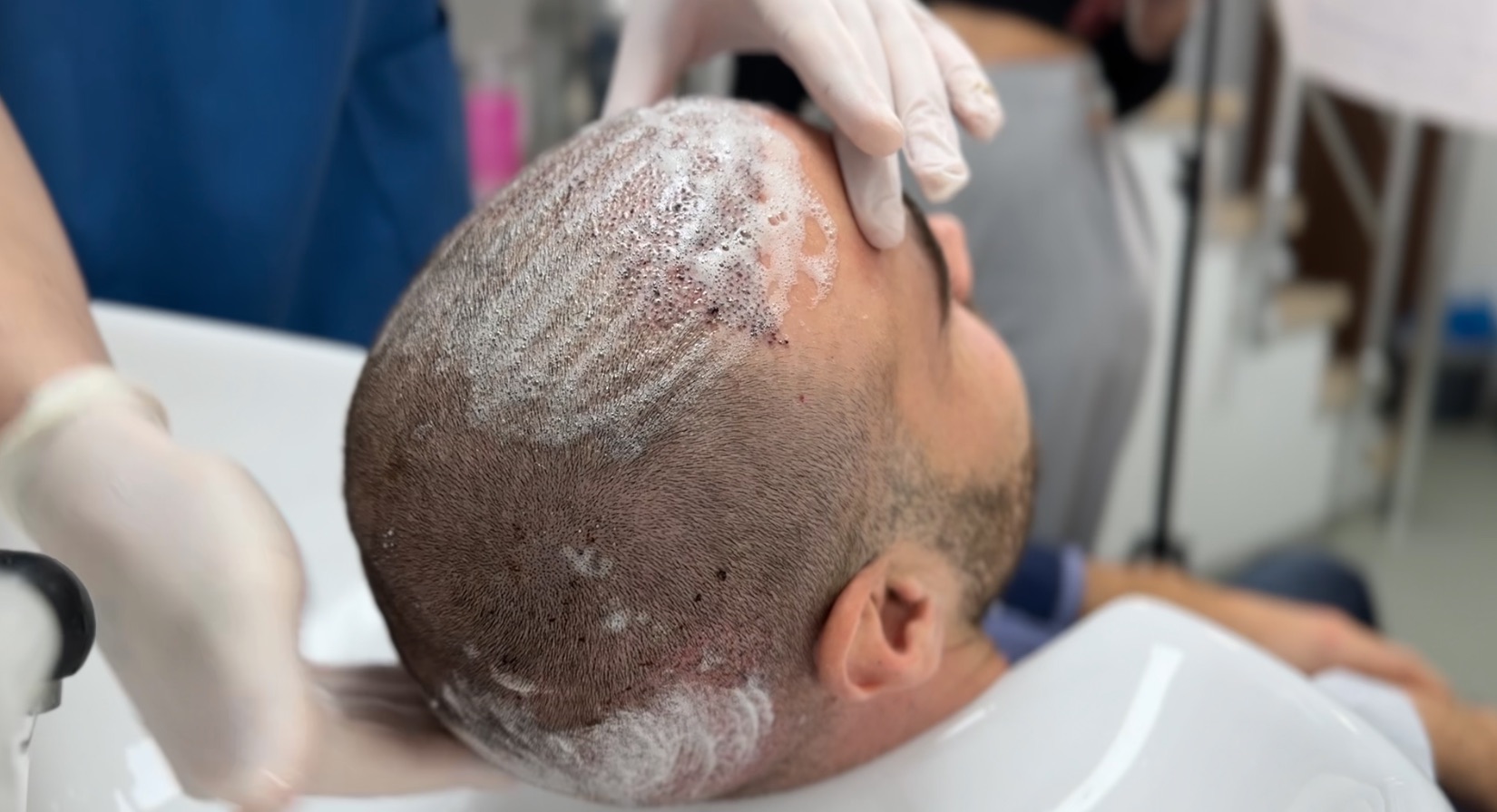
Aftercare is one of the most important package components, yet descriptions often provide little detail.
A clinic may advertise an aftercare kit and twelve months of follow-up without explaining what those services actually involve.
First hair wash
Many Istanbul clinics schedule a supervised first-wash appointment during the early postoperative period. Others provide a different washing protocol.
The timing depends on the treating physician’s instructions.
A supervised wash may include scalp assessment, gentle cleaning, and demonstrations of how to protect the transplanted areas.
Aftercare products
Packages may include shampoo, saline solution, medication, or other products. Ask which items are medically necessary, how long they should be used, and whether additional purchases will be required.
Don’t assume every supplement or cosmetic product offered by a clinic improves graft survival.
Postoperative examination
The responsible medical team should explain the expected healing process and review your condition before departure.
Ask whether the physician personally performs the examination or delegates parts of the assessment.
Remote follow-up
Some clinics schedule progress reviews using photographs or video consultations.
Ask how often these occur, who evaluates the images, and how quickly medical concerns are addressed.
What if complications develop?
Remote messaging cannot replace an in-person examination when a medical complication is suspected.
The CDC advises medical tourists to arrange continuity of care before traveling.
Our advice: A good aftercare package should explain who provides medical advice, what happens when symptoms develop, and how patients obtain appropriate treatment after returning home.
What’s Usually Not Included in Hair Transplant Packages?
The phrase “all-inclusive” can create unrealistic expectations.
Many packages cover selected services in Istanbul but exclude important expenses before and after treatment.
International flights
Flights are commonly excluded.
The total travel cost depends on your departure country, season, airline, and booking conditions.
Travel and medical insurance
Standard travel insurance may exclude planned elective procedures and related complications.
Ask your insurer about medical tourism coverage, emergency treatment, additional accommodation, and changes to return flights.
Additional hotel nights
Packages usually specify a fixed number of nights.
If you choose to stay longer or need additional observation, accommodation may cost extra.
Meals and personal expenses
Some hotels include breakfast, but lunch, dinner, and personal expenses may not be covered.
Optional medical treatments
PRP, mesotherapy, exosome products, and other supplementary services may be offered at additional cost. Evidence for some adjunctive treatments is limited or inconsistent, and certain applications may be experimental.
Ask about their medical indication, supporting evidence, risks, and regulatory status.
Treatment of complications
Additional consultations, medications, emergency treatment, or hospitalization may not be included.
Corrective surgery
A future revision procedure isn’t automatically covered by the original package.
Request written information about revision policies, eligibility, limitations, and possible costs.
Istanbeautiful Team Tip: Ask the clinic for a list of exclusions rather than relying solely on the list of inclusions. This often reveals the most significant differences between packages.
Are Unlimited Graft Packages Worth It?
Some clinics advertise unlimited grafts or fixed-price packages covering up to 4,000 or 5,000 grafts. These offers may seem attractive, particularly to patients with advanced hair loss.
However, graft count should be a medical decision rather than a promotional target.
Why donor supply important
The donor area contains a finite number of follicles suitable for transplantation. Excessive extraction can create visible thinning, scarring, and reduced options for future treatment.
Is a higher graft count better?
Not necessarily. The appropriate number depends on donor density, hair characteristics, recipient-area size, desired coverage, and possible future hair loss.
A large session may be suitable for some patients but inappropriate for others.
What does unlimited really mean?
Ask whether the clinic means an unlimited price category or an unlimited number of grafts.
A fixed-price offer should still involve a medically justified extraction limit.
Questions to ask
Request the estimated graft count, donor-area assessment, expected density, and explanation of how future hair loss has been considered.
Ask what happens if the physician determines that fewer grafts can safely be harvested.
Our recommendation: Choose a clinic that explains donor preservation and realistic coverage rather than promising the largest possible graft count.
Do PRP, Exosomes, and Other Package Extras Improve Results?
Hair transplant packages sometimes include additional treatments described as premium or advanced services. These may include PRP, exosomes, laser therapy, mesotherapy, and other products.
However, their inclusion doesn’t automatically make a package medically superior.
PRP treatment
Platelet-rich plasma involves processing a patient’s blood to concentrate platelets. Some studies suggest possible benefits in selected hair restoration settings, but protocols and evidence quality vary.
PRP isn’t an established requirement for successful hair transplantation.
Exosome treatments
Exosome-based products are sometimes marketed for hair restoration. However, clinical evidence remains preliminary, product quality varies, and regulatory approval depends on the jurisdiction and intended use.
Patients should not assume that an exosome treatment is proven to improve graft survival.
Laser therapy
Low-level light therapy has been studied for certain forms of hair loss. However, its role as a routine addition to every surgical package isn’t established.
Vitamins and supplements
Supplements may be appropriate when a clinically relevant deficiency is identified. Routine supplementation without a medical indication doesn’t guarantee improved hair growth.
Should you pay for these upgrades?
Ask whether the proposed treatment is medically necessary, what evidence supports it, and whether declining it affects the main surgical procedure.
Istanbeautiful Team Tip: We recommend comparing the core surgical plan before considering add-ons. An expensive package containing several supplementary treatments may offer less medical value than a simpler package with appropriate physician involvement and aftercare.
How to Compare Two Hair Transplant Packages
Comparing packages becomes easier when you separate medical care from travel-related services.
Imagine receiving two quotations:
Package A: $2,500
Includes FUE surgery, two hotel nights, transfers, and basic aftercare.
Package B: $3,500
Includes FUE surgery, three hotel nights, transfers, extended follow-up, and additional physician participation.
These are illustrative examples, not offers from particular clinics.
The second package may provide greater medical value if the additional physician involvement is clearly documented and appropriate.
However, the price difference may be largely attributable to accommodation or optional services.
Compare medical responsibility
Ask who performs the consultation, hairline design, extraction, recipient-site creation, and implantation.
Compare graft planning
Request the estimated graft count and explanation of donor-area preservation.
Compare the facility
Verify the actual healthcare facility and its authorization for international health tourism.
Compare postoperative care
Check the number of appointments, physician availability, remote follow-up, and complication arrangements.
Compare exclusions
Review flights, extra accommodation, medications, optional treatments, and corrective surgery policies.
Compare total cost
Calculate the complete expected expense rather than relying on the advertised package price.
Our advice: The best-value package is the one that provides appropriate medical care, clear responsibilities, and suitable aftercare at a transparent total cost.
How to Verify a Hair Transplant Package Provider in Turkey
Before booking, confirm that the procedure will take place in an appropriately authorized healthcare facility.
Turkey’s international health tourism services are regulated by the Ministry of Health.
Verify the treatment facility
Ask for the legal healthcare facility name, address, and international health tourism authorization details.
The commercial clinic brand may differ from the registered facility name.
For international health-tourism authorization, consult the Turkish Ministry of Health’s official information at https://shgmturizmdb.saglik.gov.tr/. Use the official “Authorized Health Institutions” list on shgmturizmdb.saglik.gov.tr or submit the clinic name and city.
Authorization does not guarantee surgical outcomes.
Confirm the physician
Request the responsible physician’s full name, qualifications, and surgical responsibilities.
The ISHRS recommends clear physician accountability and warns about inappropriate delegation of surgical activities.
Ask about daily patient volume
Find out how many procedures are scheduled each day and how the medical team is organized.
Patient volume alone doesn’t determine quality, but it can help you evaluate physician availability and supervision.
Review informed consent
A responsible provider should explain treatment risks, alternatives, expected outcomes, and postoperative responsibilities before obtaining consent.
Check independent patient feedback
Reviews can provide useful information about communication, travel coordination, and service experience.
However, positive ratings don’t independently establish medical qualifications or surgical outcomes.
For additional guidance, see our Common Red Flags of Turkish Hair Transplant Clinics.
How Long Should You Stay in Istanbul With a Hair Transplant Package?
Many international patients arrange a stay of approximately three to five nights for a straightforward single-day hair transplant.
However, the medically appropriate duration depends on your procedure, postoperative condition, and travel arrangements.
Example four-night itinerary
Day 1: Arrive in Istanbul, transfer to your hotel, and attend the consultation if scheduled.
Day 2: Undergo the procedure and return to your hotel for rest.
Day 3: Attend an early postoperative examination.
Day 4: Rest and complete any additional scheduled appointments.
Day 5: Return home if medically cleared.
When can you fly home?
There is no universal 48-hour or 72-hour clearance rule for every patient. The CDC identifies recent surgery and prolonged travel as potential blood-clot risk factors in susceptible individuals.
Your physician should assess your medical history, recovery, and flight duration.
What if your package includes only two nights?
Ask whether the schedule allows sufficient time for the required postoperative appointments. A short package may be appropriate in some circumstances, but it shouldn’t dictate medical clearance.
Can you explore Istanbul?
We recommend scheduling most sightseeing before surgery. Afterward, prioritize rest and follow your physician’s restrictions concerning sun exposure, strenuous activity, swimming, and scalp protection.
For detailed planning, read our How Long Should You Stay in Istanbul for a Hair Transplant? guide.
Questions to Ask Before Booking a Hair Transplant Package
Before paying a deposit, request written answers to the following questions.
Medical care
- Who is the responsible physician?
- Who performs extraction, recipient-site creation, and implantation?
- What is the registered treatment facility?
- How is the graft count determined?
- How will my donor area be protected?
Package services
- What medical services are included?
- How many hotel nights are provided?
- Which airport and clinic transfers are covered?
- Are medications and aftercare products included?
- Which services require additional payment?
Recovery and follow-up
- When are the postoperative appointments?
- Who assesses my fitness to travel?
- How does remote follow-up work?
- What happens if complications develop?
- What are the cancellation, refund, and revision policies?
Common Patient Questions
How much does an all-inclusive hair transplant package cost in Istanbul?
International patients may encounter packages ranging from approximately $1,800 to $5,000 or more in 2026. The price depends on the provider, physician involvement, treatment complexity, graft requirements, and included services. Premium or corrective procedures may cost considerably more. These are indicative ranges, so request an individualized written quotation before booking.
What is included in a hair transplant package in Turkey?
Many packages include the procedure, consultation, local anesthesia, hotel accommodation, airport transfers, an initial postoperative examination, and basic aftercare. However, inclusions vary considerably. International flights, travel insurance, extra hotel nights, and complication-related expenses may be excluded. Always request an itemized quotation showing exactly what the clinic provides.
Are cheap hair transplant packages in Istanbul safe?
A lower-priced package can be appropriate when treatment takes place in an authorized facility with qualified medical professionals and suitable postoperative care. Price alone doesn’t establish safety. Verify the responsible physician, surgical responsibilities, donor-area planning, and complication arrangements. Be cautious of providers that refuse to explain their medical team or treatment location.
Is FUE or DHI better for a hair transplant package?
Neither method is universally superior. FUE describes the extraction of individual follicular units, whereas DHI commonly refers to implantation using an implanter device. The appropriate approach depends on the patient’s hair loss, donor characteristics, treatment goals, and physician’s assessment. Choose based on medical suitability rather than promotional technique names.
Do hair transplant packages include flights?
International flights are commonly excluded from hair transplant packages in Istanbul. Most offers focus on the procedure, accommodation, local transfers, and initial aftercare. Confirm whether the quoted price includes flights, meals, medications, and additional medical services. Budget for possible flight changes or extra accommodation if recovery takes longer than expected.
How many nights are included in hair transplant packages?
Many international packages include two or three hotel nights, but arrangements differ between clinics. Some offer longer stays or additional nights for an extra fee. The appropriate trip duration depends on your treatment schedule, medical condition, postoperative appointments, and flight arrangements. Ask the physician to confirm your expected recovery and travel schedule.
Are premium hair transplant packages worth the extra money?
A premium package may offer additional physician participation, more detailed consultations, extended aftercare, or upgraded accommodation. However, premium labels aren’t standardized and don’t guarantee superior results. Compare the actual medical responsibilities, treatment plan, facility, and follow-up arrangements before deciding whether the additional cost provides meaningful value.
Do all-inclusive packages cover complications?
Not necessarily. Some packages include initial postoperative assessment and remote follow-up but exclude additional medical treatment, hospitalization, or corrective surgery. Ask the provider for written information about complication management and associated costs. Check whether your insurance covers planned elective surgery abroad and any related medical expenses.
Are unlimited graft hair transplant packages a good deal?
An unlimited-graft offer should be evaluated carefully. The donor area contains a limited supply of follicles, and excessive extraction can cause permanent thinning or scarring. A responsible physician should determine the appropriate graft count based on donor density, recipient-area needs, and future hair loss. A higher graft count doesn’t automatically mean better results.
How do I choose the best hair transplant package in Istanbul?
Start by verifying the healthcare facility and responsible physician. Compare individualized medical assessments, graft planning, surgical responsibilities, written quotations, and postoperative care. Consider hotel and transfer arrangements after confirming the medical details. The best package is the one that meets your treatment needs with appropriate medical care and transparent pricing.
For further research, explore our Best Hair Transplant Clinics in Istanbul, Cheap Hair Transplant in Turkey, and Traveling to Turkey for a Hair Transplant guides.
Medical References & Trusted Resources
The following references support the medical information in this guide concerning hair transplant techniques, physician qualifications, donor-area management, graft planning, postoperative recovery, surgical complications, international medical tourism, and healthcare facility authorization in Turkey.
- International Society of Hair Restoration Surgery (ISHRS) – Consumer Advocacy: Professional guidance on selecting qualified hair restoration physicians, verifying surgical responsibilities, and identifying potentially unsafe hair transplant practices.
- International Society of Hair Restoration Surgery (ISHRS) – Hair Transplant Black Market Red Flags: Patient safety information concerning unlicensed surgical personnel, misleading clinic marketing, excessive graft promises, donor-area damage, and inadequate physician involvement.
- International Society of Hair Restoration Surgery (ISHRS) – Consumer Alert on False Advertising: Professional warnings about misleading treatment claims, unauthorized surgical activities, physician accountability, and risks associated with inappropriate delegation.
- National Health Service (NHS) – Hair Transplant: Independent medical information on hair transplant suitability, FUE and FUT procedures, possible complications, early graft protection, postoperative recovery, and expected hair growth.
- National Health Service (NHS) – Cosmetic Surgery Abroad: Guidance on selecting overseas medical providers, checking surgeon qualifications, planning recovery, evaluating treatment costs, and arranging follow-up care.
- Centers for Disease Control and Prevention (CDC) – Medical Tourism: Guidance on receiving surgical treatment abroad, infection risks, postoperative complications, international air travel, and continuity of medical care after returning home.
- Centers for Disease Control and Prevention (CDC) – Blood Clots During Travel: Medical information on deep vein thrombosis, pulmonary embolism, prolonged immobility, recent surgery, and individual travel-related risk factors.
- Turkish Ministry of Health – Authorized Healthcare Providers: Official information and lists of healthcare facilities authorized to provide international health tourism services in Turkey.
- Turkish Ministry of Health – International Health Tourism: Official regulatory information concerning healthcare facility authorization, international health tourism requirements, and oversight of medical tourism providers.
- HealthTürkiye – Official Health Tourism Platform: Türkiye’s official health tourism platform providing information about healthcare services, participating facilities, and international patient arrangements.
About Our Research, Editorial Independence and Medical Review
Our hair transplant and medical tourism coverage draws on clinic visits, physician questionnaires, professional documentation, regulatory information, treatment research, and publicly available patient feedback.
Our editorial assessments examine physician qualifications, direct surgical responsibilities, hair transplant techniques, donor-area planning, daily patient volume, facility authorization, clinical transparency, pricing, and postoperative care.
For this guide, we focus on comparing hair transplant packages in Istanbul, including medical services, surgical responsibilities, graft planning, accommodation, transfers, optional treatments, pricing transparency, and international patient follow-up.
We distinguish independently verified information from clinic-reported statements and patient-reported experiences.
Medical disclaimer: This guide provides general educational information, practical travel guidance, and independent editorial research. It does not replace an individual medical consultation or establish that any particular package, clinic, physician, price range, or surgical technique is suitable for a specific patient. Hair transplantation carries potential medical and cosmetic risks, including infection, bleeding, scarring, donor-area damage, poor graft growth, and unsatisfactory results. Individual outcomes vary. Patients should consult a qualified medical professional before undergoing treatment.

