
Most people come to Sultanahmet expecting crowds, noise, and long lines. Then they step into the Şerefiye Cistern, and everything drops away. This is not the cistern everyone talks about. It’s smaller. Quieter. More controlled. And that’s exactly why it works.
You enter from a normal city street and descend into a space that has been holding water, silence, and history for more than sixteen centuries. No grand staircase. No dramatic reveal. Just a gradual shift from daylight into stone, columns, and shadow.
The Şerefiye Cistern dates back to the Byzantine era, most likely the reign of Theodosius II. It once fed the city’s palaces and baths, doing its job invisibly for generations. Today, it does something different. It asks you to slow down.
If you’re planning to visit the Şerefiye Cistern, our guide is here to help you understand what kind of experience you’re walking into. Not just the history, but the rhythm of the visit. How long to stay. When it feels busiest. Why this cistern feels so different from the others nearby.
This isn’t a place you rush through between landmarks. It’s a pause. A short one, but a meaningful one.
At a glance: Şerefiye Cistern Istanbul
The Şerefiye Cistern doesn’t announce itself loudly. You step off a busy street and drop into something older, quieter, and surprisingly intimate.
This cistern dates back to the early Byzantine period, most likely to the reign of Theodosius II in the 5th century. There are no inscriptions spelling that out. The clues live in the architecture. Proportions. Vaulting style. Materials. The kind of details historians read the way others read street signs.

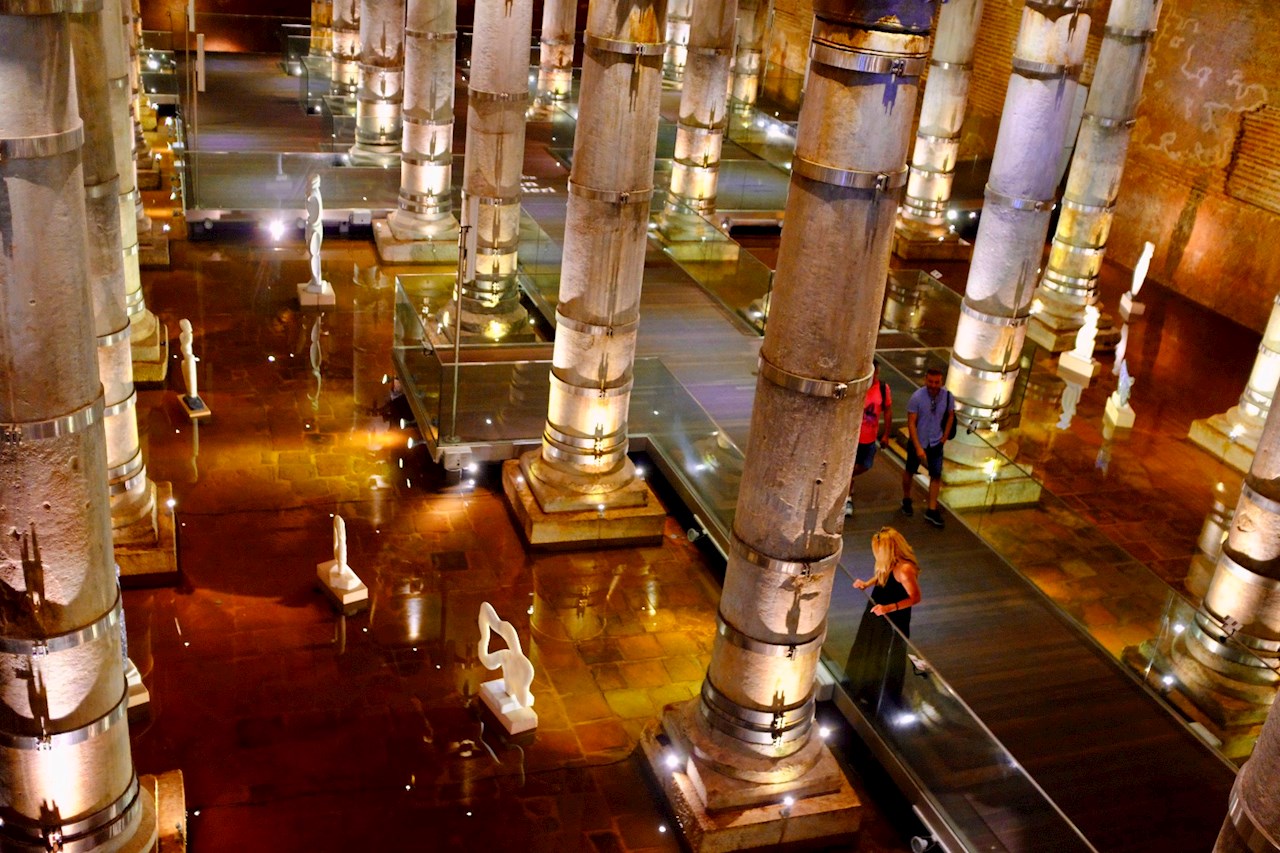
Inside, the space opens to roughly 24 by 40 meters, carried by 32 marble columns topped with Corinthian capitals carved from Marmara Island stone. The vaults rise above in a rhythm that feels deliberate, not decorative. Compared to the Basilica Cistern, this place is smaller and calmer. Fewer columns. Less spectacle. More presence.
Cisterns mattered here. In a city shaped by sieges and population growth, water storage was survival. Şerefiye was part of that hidden system, feeding major structures like the Great Palace baths and nearby complexes. Thick walls. Waterproof plaster. An original floor still intact. That level of preservation is rare.
The cistern stayed hidden for centuries. It resurfaced in 2010 beneath the Arif Paşa estate, and the area around it was reshaped into an archaeological park. Today, it’s both ancient infrastructure and contemporary exhibition space, without feeling forced.
Istanbeautiful Team note:
“This cistern feels closer than the others. You don’t look at it from afar. You share the space with it.”
No Regrets Booking Advice
What to expect inside the Şerefiye Cistern
This isn’t a walk-through with plaques. It’s an experience that unfolds.
Once inside, light and sound take over gently. The cistern hosts a 360-degree projection mapping system, the first of its kind used in a historic structure like this. The show doesn’t compete with the architecture. It uses it.

The experience runs in clear chapters. First, the space introduces itself. Walls, columns, ceilings come into focus through subtle 3D effects. You start noticing scale and geometry before story.
Then water takes the lead. Aqueducts, channels, and distribution routes appear around you, tracing how water once moved through the city. It’s schematic but intuitive. You don’t need background knowledge to follow it.
The next layer brings memory. Byzantine imagery blends into Ottoman motifs. Icons dissolve into tile patterns. Sixteen centuries compress into a visual rhythm that feels more reflective than dramatic.
The final section shifts again, touching on the founding years of the Republic and then slowly stripping the projections away. The cistern returns to itself. Stone. Columns. Stillness.
For a moment, there’s nothing to do but stand there.
Istanbeautiful Team insight:
“Don’t rush out. Let the lights fade fully. That quiet ending is part of the visit.”
If you’re expecting a museum, adjust your mindset. This is closer to a pause in the city. One that just happens to be sixteen hundred years old.
Visiting Hours & Admissions
Opening Hours
The Şerefiye Cistern is open every day from 09:00 to 19:00.
Late morning and early afternoon tend to be busier, especially when Sultanahmet crowds spill over. If you want space to stand still during the projection, earlier or later in the day feels better.
Istanbeautiful Team tip:
“Try to enter when you’re not in a hurry. The experience needs a few quiet minutes to settle.”
Ticket Price
Please double check serefiyesarnici.istanbul for the tickets and opening hours.
Accessibility
The cistern is wheelchair accessible, but visitors need to bring their own wheelchair. There is no rental service on site.
An elevator provides access to the visiting platform, and the viewing area itself is designed to allow smooth movement. Paths are flat and wide enough to take in the full experience comfortably.
Entrance is free of charge for disabled visitors, and one companion is also admitted free.
How to Get There?
Location
The Şerefiye Cistern is located on Piyer Loti Street, just a short walk from Sultanahmet Square.
If you’re already visiting Hagia Sophia, the Blue Mosque, or the Basilica Cistern, you’re close. This one often gets added almost accidentally, and ends up being the surprise favorite of the day.